

ROUGE NOIR
A biography by Kassia St Clair
PHOTOGRAPH BY CHARLES NEGRE
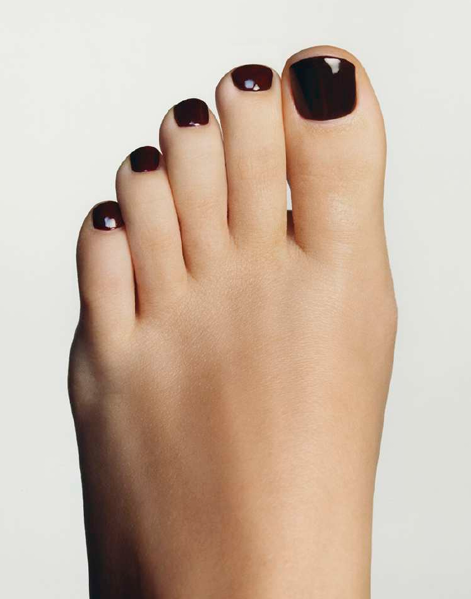
Around the middle of the 1st century AD, the Roman historian Pliny the Elder wrote about a shade with peculiar power. “It is this colour,” he said, “that distinguishes the senator from the man of lesser rank; by persons arrayed in this colour are prayers addressed to propitiate the gods; on every garment it sheds a lustre.” Although it was usually called Tyrian purple, the precise hue was described by him as “the colour of congealed blood, blackish at first glance but gleaming when held up to the light”. A colour, in other words, very much like Rouge Noir.
It is perhaps unsurprising, then, that these two similar shades have become the stuff of legend. The former as the pre-eminent dye of the ancient world, the latter as an iconic moment in make-up. Late in the evening of March 8, 1994, two days before Karl Lagerfeld was due to present the Chanel Fall-Winter 1994/95 Ready-to-Wear collection, one small detail had yet to be finalised: the colour of the models’ nails. This was how Dominique Moncourtois and Heidi Morawetz, who together oversaw Chanel’s make-up studio at the time, found themselves mixing various pigments together to make something daring and new. What they sought was a varnish right at the tipping point between red and black. The result, as everyone now knows, was Rouge Noir. For Thomas du Pré de Saint Maur, Global Head of Creative Resources Fragrance and Beauty at Chanel, the shade was imbued with this combination of rebellious, late-night tinkering and creative freedom. “It wasn’t premeditated. I think this is why it made history, because it was spontaneous.”
It’s certainly true that, once unleashed on the catwalk, it created a sensation. This was an era of grunge, Britpop and pop punk, Nirvana and The X-Files. Rouge Noir encapsulated the moment, but with a twist, because it was from Chanel. Then, as now, the maison’s name was a byword for sophistication and elegance and its release of this darkly gothic, vampy shade created a frisson. A blend of two of Chanel’s classic colours, red and black, it was simultaneously avant-garde and chic. Stylish but with a punk-rock edge. Upon release, it soon began selling out across Europe and America, where it was sold under the name Vamp. Rumours began circulating that the nails of the character of Mia Wallace in the 1994 film Pulp Fiction were painted in the shade. Strange as it may seem, because today it has become a touchstone for Chanel – a classic colour and part of its patrimoine, or heritage – when it first appeared it had the power to shock. As one contemporary commentator later put it, Rouge Noir became “this ridiculous global phenomenon. It was such an outrageous colour.”
The plural quality this shade possesses, of being both audacious and refined, was recognised by Gabrielle Chanel herself. She had always been drawn to deep red. It was, she told Elle magazine in 1963, “the colour of life, of blood”, a comment that eerily recalled Pliny’s words from 2,000 years earlier. Her apartment at 31 rue Cambon in Paris was decorated with deep crimson coromandel screens. Sketches, illustrations and photographs depict her wearing the colour and a 1926 article from American Vogue reported that, “next to black and white”, her favourite colour was a deep shade of red. “[T]he garnet colour, like the inside of a black cherry […] that is often called ‘black-red’.” Throughout history, bold and powerful colours have appealed to bold and powerful people.