

SHINE ON
By Sarah Brown
PHOTOGRAPHS BY CHARLES NEGRE
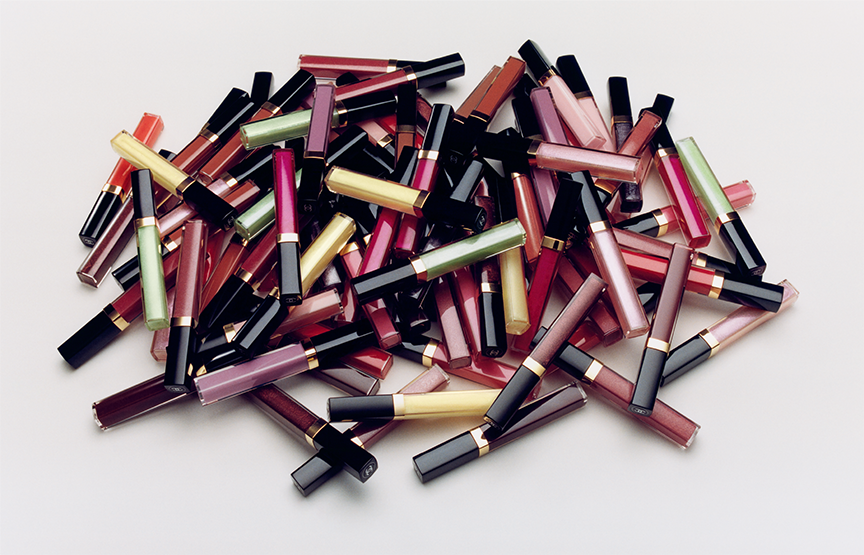
Youthful yet grown-up. Polished yet the very definition of carefree ease. The writer and beauty connoisseur Sarah Brown reflects on the eternal allure of lip gloss
VERY FEW beauty products follow us through the different eras of our lives. Our skin changes. Our taste changes. Our mood changes. What’s cool changes. We might faithfully commit to one staple or another, but something better eventually comes along.
How is it that lip gloss stays? How is it that a product that seems so frivolous amid the tangle of the other, more serious items piled on our vanities and stocked in our make-up bags has made it into every pocket and every handbag, and when one comes to think of it, nearly every decade of our lives?
It finds us as tweenagers. Lip gloss – it might be clear or have a touch of sparkle; it might smell (or indeed taste) like strawberries or salted caramel; it might be dispensed via rollerball or a squeezy tube – is among the vaguely appropriate cosmetic items a budding young woman (or man) might use. A step up from lip balm. Parent-approved. A thrilling yet subtle embellishment that says, “Ta-da, here I am.” Lip gloss enters our lives in that moment when we are coming into our own, becoming conscious of our individual sense of style and – dare I say – capacity for glamour.
“It was like wearing candy and felt like the gateway to make-up – that, ‘Oh my God, I’m not quite an adult but I can pretend to be,’” the make-up artist Pati Dubroff says of discovering lip gloss in her formative preteen years. “It was definitely a rite of passage. Lip gloss made me feel like I was on the verge of the world I wanted to step into and be part of.”
Unlike straightforward essentials like mascara or eyeliner, lip gloss is full of contradictions. It’s youthful yet grown-up. Polished yet the very definition of carefree ease. Innocent while, on the right mouth, sexy. Subtle but, with a dash of sparkle, dazzling. It’s minimalist (see: 1990s gleam). It’s maximalist (see: 1980s frost). It’s make-up, yet depending upon the formulation (hydrating, plumping, line-smoothing), it’s also skincare.
Lip gloss follows us into adulthood, where – who knows – it might still taste like cherries, if that’s your thing, or perhaps a more sophisticated, breath-freshening mint, but its role is now as a finisher. In the world of make-up, this is the closer. It’s that final layer that pulls things together, gliding over lipstick to add dimension and oomph, or simply over bare lips as a flattering, light-catching veil.
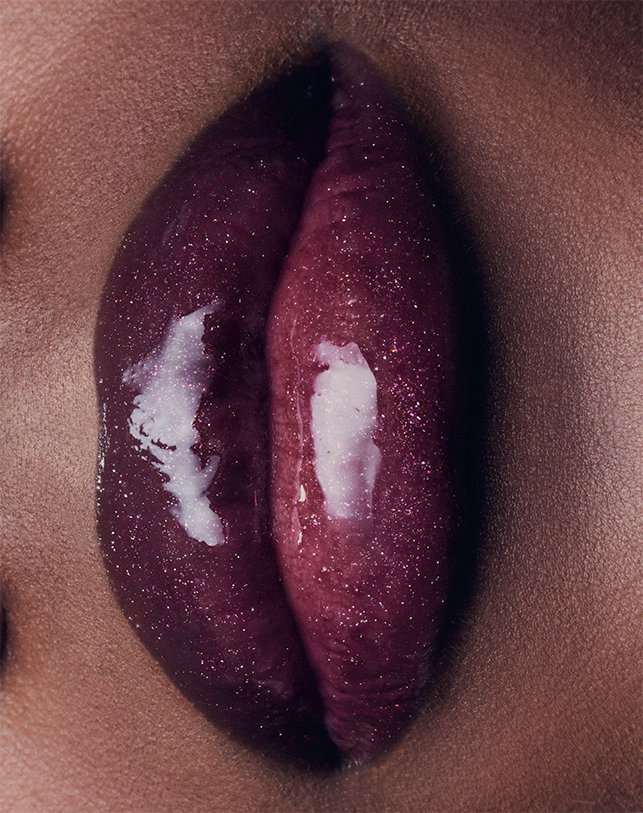
It’s the thing we reach for when we don’t feel like wearing lipstick. When we want maximum impact with minimal commitment. When we don’t have a mirror. When we are late. When we want to feel fresh and pretty. When we are on holiday. Or a date. When we are taking it easy but keeping it chic.
“Luxury without effort,” is how the Shanghai-based make-up artist Valentina Li – a member of Chanel’s Comètes Collective working closely with the Chanel Makeup Creation Studio – describes it. “I like the gesture of lip gloss – instant shine with just one swipe.”
“There’s an ease to it,” Pati Dubroff agrees. “And it feels like you’re doing something good for your lips.” She is famous for her red-carpet work with actresses including Margot Robbie, a reputation minted by her magical ability to create looks that are natural and appear un-made-up but are sufficiently smouldering and paparazzi-proof. Low-key glamour on a world stage. She reaches for gloss when she wants a client “to just look like an elevated version of themselves”. Used as a highlight, it can “open up” a face, she says, to bring out radiance and “make lips look more alive”. It’s also a natural volumiser. “You want the lip to have fuller dimension. Gloss is the thing that picks up the light.”
Lip gloss may have burst onto the scene as a full-blown cultural phenomenon in the 1970s – Bonne Bell’s flavoured Lip Smackers (originally marketed to skiers) debuted in the US in 1973, and the fever for high-wattage, high-gloss everything in the disco age took over from there – but the first commercial lip gloss was introduced in the early 1930s in Hollywood, as matte lipstick appeared flat on black and white film. The pomade added dimension on camera. A 1938 issue of American Vogue noted that actresses and real women alike applied it over their lipstick to give lips “luscious shine without having to keep moistening them”. (If you want to get really technical, though, truly the first lip gloss on record was developed by the ancient Egyptians – beauty aficionados notable for also popularising milk baths, henna and kohl – as a salve made of plant oils or animal fats and used by men and women to protect their lips from the unforgiving dry and dusty Saharan climate.)
Lip gloss has certainly come a long way since 3100BC. What makes a great gloss today?
For one thing, the best new glosses no longer get stuck in your hair when you go outside and the wind blows. Believe it or not, this universal vexation was front of mind at the Chanel Makeup Creation Studio outside Paris, where Rouge Coco Hydra Gloss, the blockbuster new launch arriving this spring, was carefully hatched.
“Before, I was not a gloss person,” admits Nathalie Lasnet, Vice-President of the Chanel Makeup Creation Studio and the woman who is likely behind much of what is in your make-up bag. “I’m very proud of this gloss. It’s a product you want to apply and reapply,” she says, instinctively reaching for a double-C-embossed compact and a slim tube – an early lab sample – and running the doe-footed wand over her lips.
“This gloss is very different from what we had before – more obsessive,” she continues, pursing her freshly polished lips, satisfied with her work. “We enhanced its shine and we’ve created a non-sticky texture that leaves a glazed effect.” She describes the new formula as “caring”. The team added proprietary ingredients – camellia ceramides and a hydra-peptide complex – to build in a promised 24 hours of hydration and to boost its volumising effects. “As soon as you apply it, it hydrates, smooths and plumps visibly. The more you apply, the more it helps,” she says.
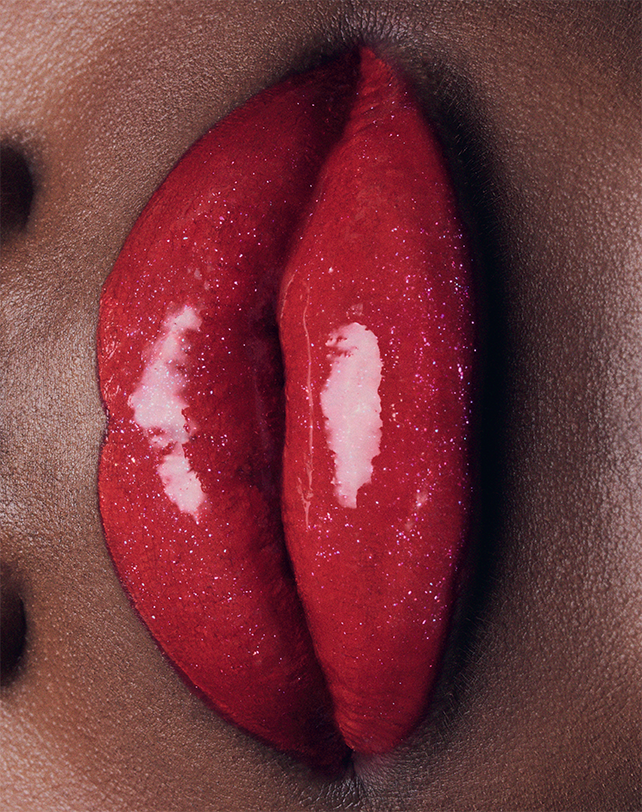
Indeed, it’s no longer enough to look shiny. Lip products that double as treatment – hybrids with notable skincare benefits – are increasingly what we’re all after. Especially as we age. “I’m at a stage of my life where I’m drawn to formulas with more hydration, whether that’s a tinted balm, a sheer gloss or an oil – something that’s going to give real nourishment to my lips,” Pati Dubroff says. Even though we tend to think of lip gloss as slightly throwaway, and perhaps forever positioned in teenage territory, the new luxe formulas are in fact quite flattering for what we might call the more mature mouth. First there is the hydrating aspect (juicy, comfortable), then factor in the plumping power (either actual technology or the optical illusion created by strategic shimmer and a reflective sheen), and finally there is a lot to be said for the softer, more forgiving lines offered by a sheer veil of colour: no hard, pinched edges. Still, Pati Dubroff stresses the importance of a lip liner – invisibly applied as a first step – to secure one’s borders, with gloss applied just in the centre, to prevent it from oozing into the corners. “The pencil is crucial because, as we get older, we have more texture around the lip line and we don’t want seepage. We must be careful the gloss doesn’t bleed,” she says.
Suddenly, we’re taking lip gloss seriously.
Valentina Li worked closely with the Chanel Makeup Creation Studio to evaluate formula submissions, test-drive samples and develop the shades. “I wanted a gloss that has buildable colour and mirror-like shine, that I can play with in many ways,” she says.
Valentina Li and Nathalie Lasnet designed the range of 18 shades to work as a modern-day gloss wardrobe. Consisting of different colour families – gourmet and “appealing”, deep and glamorous and natural and easy – with varied finishes, from elegant milky-sheers to punchy shimmers, the lineup includes a gloss for every mood, season and occasion. Among her favourites, Valentina Li points to Icing, a clear, glossy shade “for casual days”, Charms, “a pigmented poppy-pink for dates”, and Accessoire, “a sheer beige-nude for work”. Nathalie Lasnet is enamoured of Solaire (red is her colour), as well as Superposition, a coral that “evokes the sweetness of guava”, and Fabuleuse, a limited-edition icy yellow that can be layered over others for added effect. “This citrus, it’s like lemon sorbet,” she marvels.
“We play. We sparkle, or we don’t sparkle. You’ll want five or six,” Nathalie Lasnet continues. “It’s very chic and very Chanel.”